


Too much happens in the world to talk about, let alone understand. We need beliefs, but I think it’s important to wonder… what do they miss?
Writing "Bay Area Abroad: Innovation through Fragmentation" in San Francisco made it easy to drink the Kool-Aid: the Bay was always the world's core for new tech—an assumption that explains its centrality in recent geopolitics. But, thinking this misses an important part of the economy's story: this chapter covers how Japan's miraculous growth spilled over into challenging the Bay Area's lead in chip innovation by the 1980s.
Table of Contents: Introduction | How the Bay Area Makes New Tech | The Cold War | Japan | Globalization of the 1990s | China into Today | Today’s Fragmenting Flashpoints | Assessing The Engine & The Exposure | Conclusion
Your feedback on these prior chapters has been so helpful. Ahead of formal print at BACEI, help me sound somewhat coherent. I’m one text message away.
As rivalry with the Soviet Union grew, the United States sought to help its allied economies across Europe and Asia recover. Among them, the Japanese government managed its economy’s recovery so well—thanks to generous aid, loans, and protectionist policies—that an ecosystem of corporations emerged by the 1970s capable of worldwide competition; the Bay Area was not immune and lost the lead on the frontier in new semiconductors.
This chapter observes a different way of fragmentation arising. In the 1980s, foreign companies had benefitted from their own government’s assistance that it impeded Bay Area technology companies’ claim to the civilian market share of the frontier. Earlier, the Cold War prompted Washington to fuel fragmentation. Here, cooperation with Japan for decades inadvertently led to fostering competition. But Tokyo rebuilt its civilian-only economy in a way that lacked the same flexibility of the Bay Area engine.
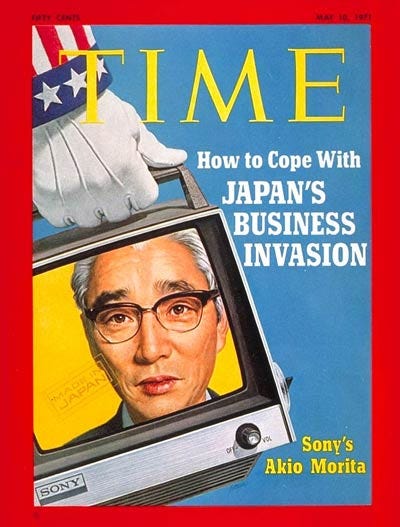
Starting from a postwar pile of rubble in a nation almost devoid of raw materials, Japan’s businessmen have built an economic superpower. Today it is flooding markets from Manila to Milwaukee with shoes, ships and steel, cameras, cable, cloth and cars, transformers, TV sets, tape recorders and, of course, the ubiquitous transistor radios. To many admiring but fretful Westerners, Japan has become a corporate state, and is even referred to as “Japan, Inc.” - TIME, May 10, 1971, Business: Japan, Inc.: Winning the Most Important Battle1
Japan Manages a Miracle
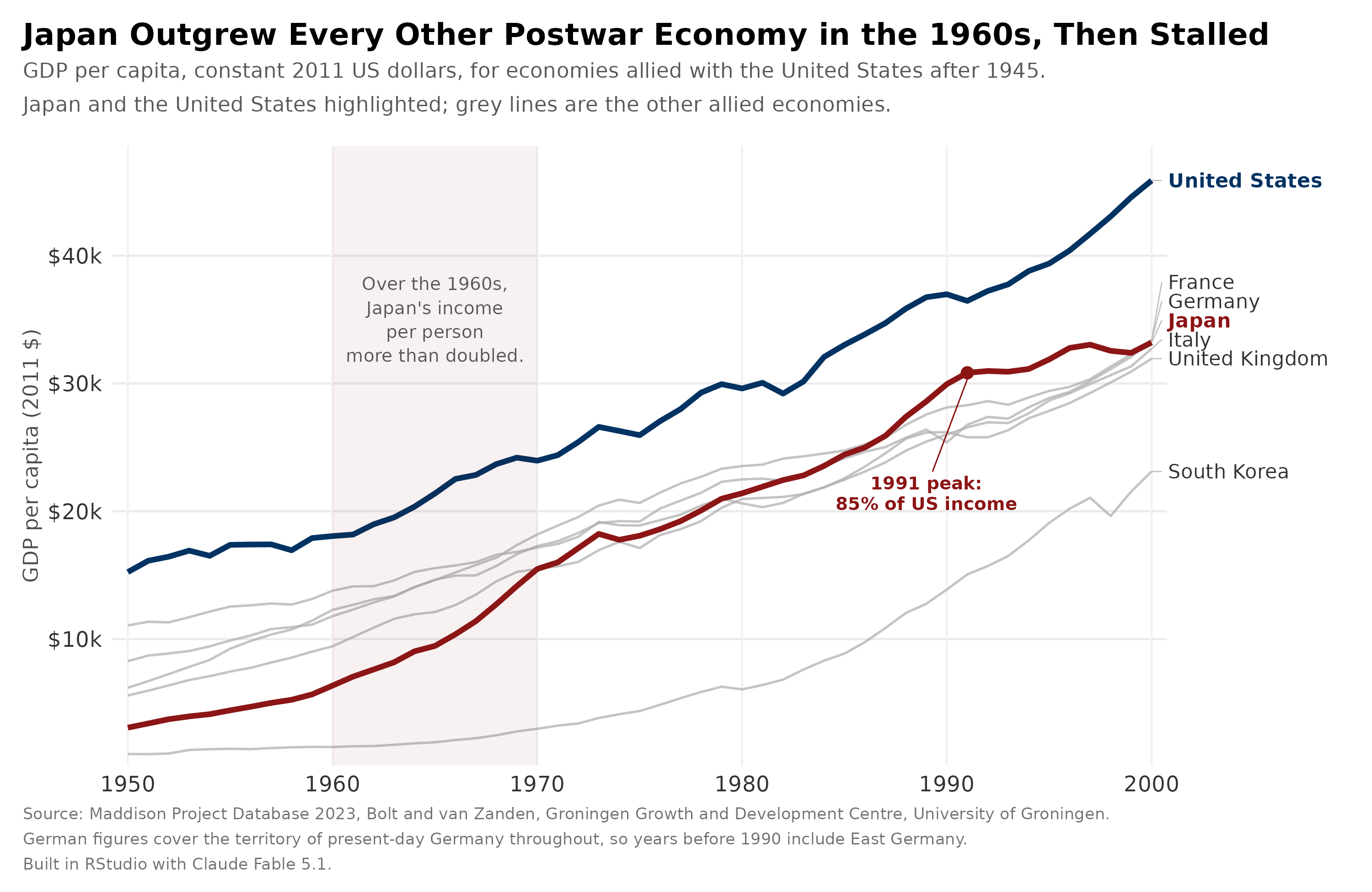
Three decades of rapid growth characterized Japan’s “economic miracle” by exporting more and more valuable goods overseas. Japan began by building a manufacturing base of raw inputs into exporting more expensive goods. By the 1970s, Japanese goods were flooding markets worldwide. During the 1980s, the fear drew a response from leading Bay Area technology companies to counter Japan’s rise.
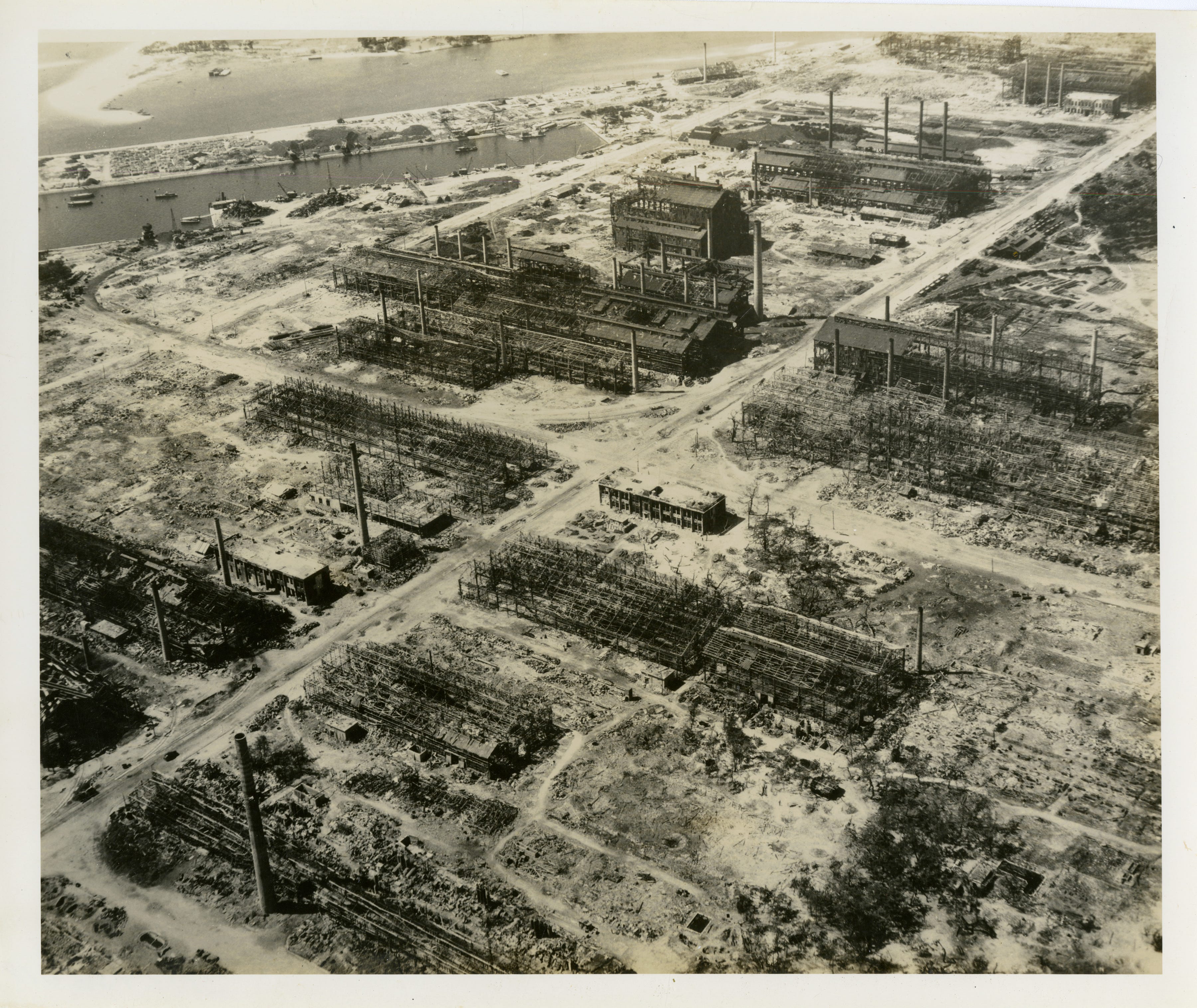
During the 1950s, Japan initially relied on protectionist policies and tariffs. Out of World War II, Japan depended on grant aid and favorable trade policies to help regrow its decimated economy.2 The government enacted democratic reforms but kept the reins over its economy; known as keisha seisan hōshik, “priority production policy” was a series of managed reforms that directed entire jobless communities and capital into coal and steel, and iron production. These reforms provided the base to moving into explosive growth in exporting shipbuilding and electric power.34
Demand for Japanese goods in recovering allied civilian markets—coupled with the US governments appetite for industrial exports out of Korean war—drove growth. By the early 1960s, the Japanese economy allowed more investment to fuel more capital-intensive industries in tools, motor vehicles, and electronic devices to fuel its economy. Tokyo’s exports grew 18.4% per year on average over the 1960s and its gross domestic product at an average of 10.5%.56
keiretsu: Japan Comes to Compete
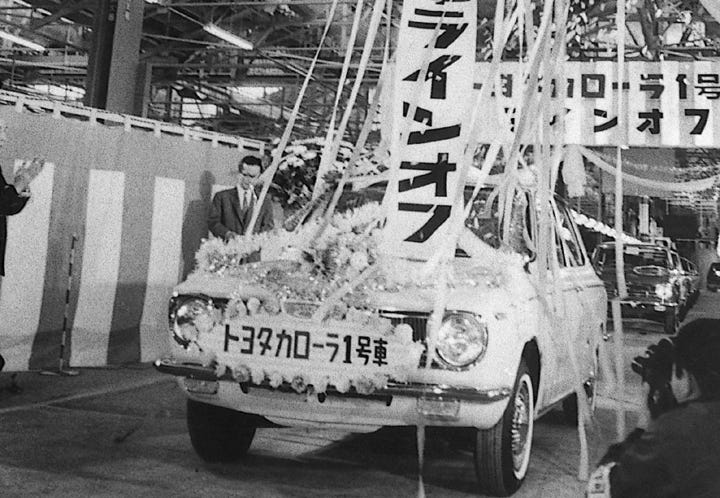
How did Japan manage to build a mature economy capable of capturing valuable demand overseas? As industries matured, a dense network of corporations and private banks in a model known as keiretsu, “group” in Japanese, arose to produce complex products.
The earlier policies that concentrated talent and capital into heavy industry provided the conditions for these new groups; a new alliance of large, diversified corporate groups webbed supply chains across industries.78
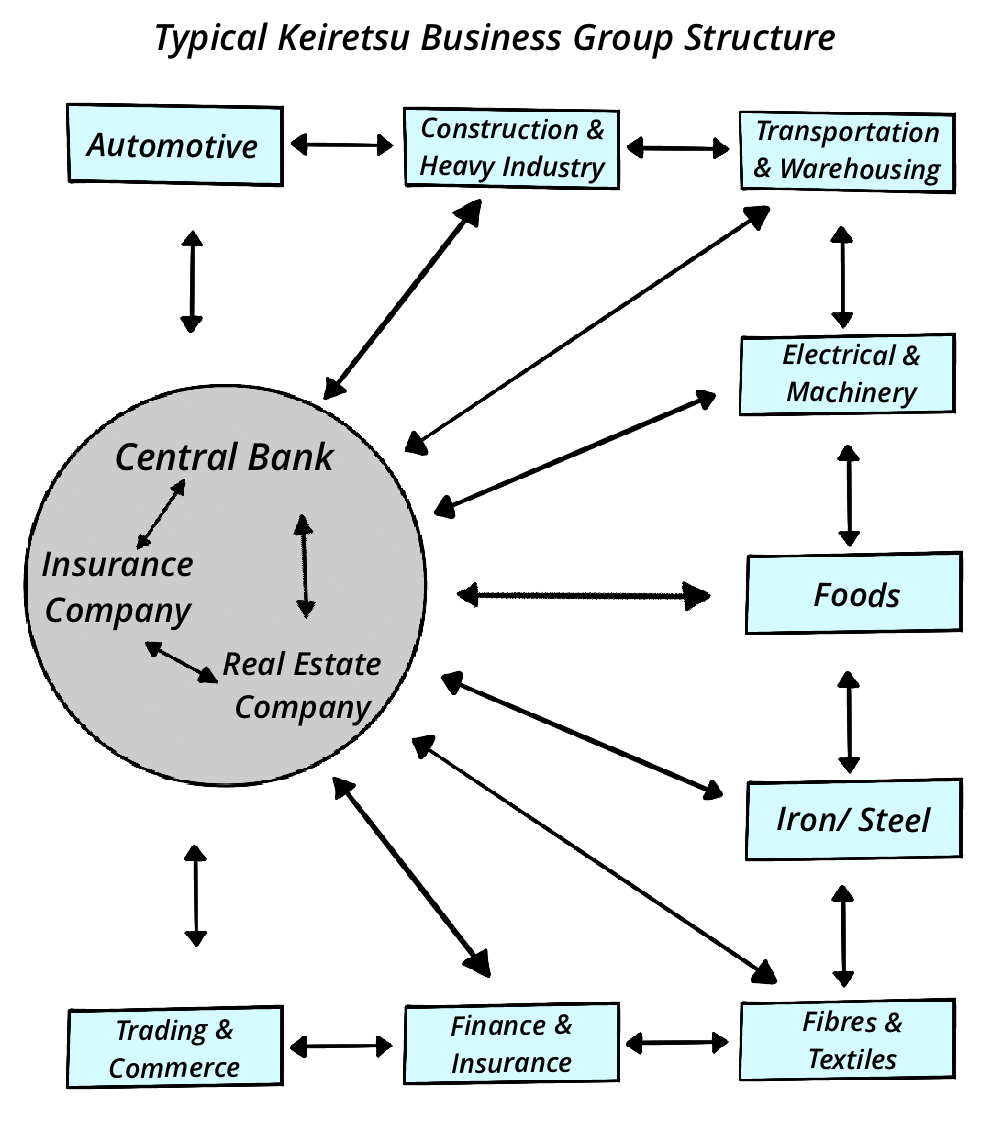
Such incredible growth under keiretsu over the 1960s inevitably captured market share from competing companies. By 1970, trade ministers worldwide were feeling pressure from their own companies to raise import quotas.9 As Japanese textiles, shoes, autos, and electronics flooded American markets, Tokyo reported its first net US trade surplus in 1965.10 By 1971, Americans were importing 30% of all Japanese exports.11
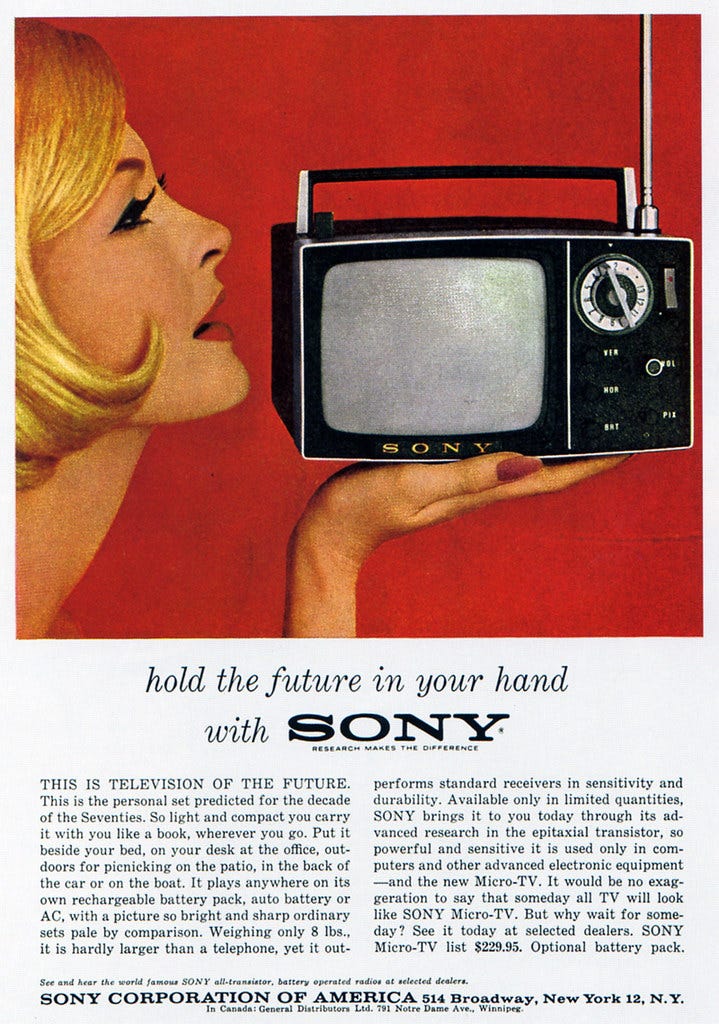
Since [1964], the popularity of Sony TVs, Nikon cameras, Panasonic radios, Toyota and Datsun cars, and Honda and Yamaha motorbikes has turned the picture upside down. - Time Magazine, 197112
The Center Shifts
Japan didn’t out-innovate the Bay Area, but rather out-manufactured companies to capture market share. DRAM semiconductors were an innovation whose products would commoditize showing little differentiation, low prices and margins, high reliability, and easy replication.
Japan wielded the momentum of its managed economy of keiretsu into the semiconductor industry, even as the original chip designs arose in America. The Japanese government funded keiretsu groups NEC, Toshiba, and Hitachi with lab funding to kickstart their own R&D to improve manufacturing. This would come to lead the semiconductor market for production.13
The idea, first designs, and patents for DRAM originated out of New York’s IBM between 1966 to 1968.14 Silicon Valley stayed true to its name. Soon, Mountain View-based Intel partnered to commercialize the first DRAM chip in 1970.15 The designs would end up in the main memory of mainframe computers around the world.16
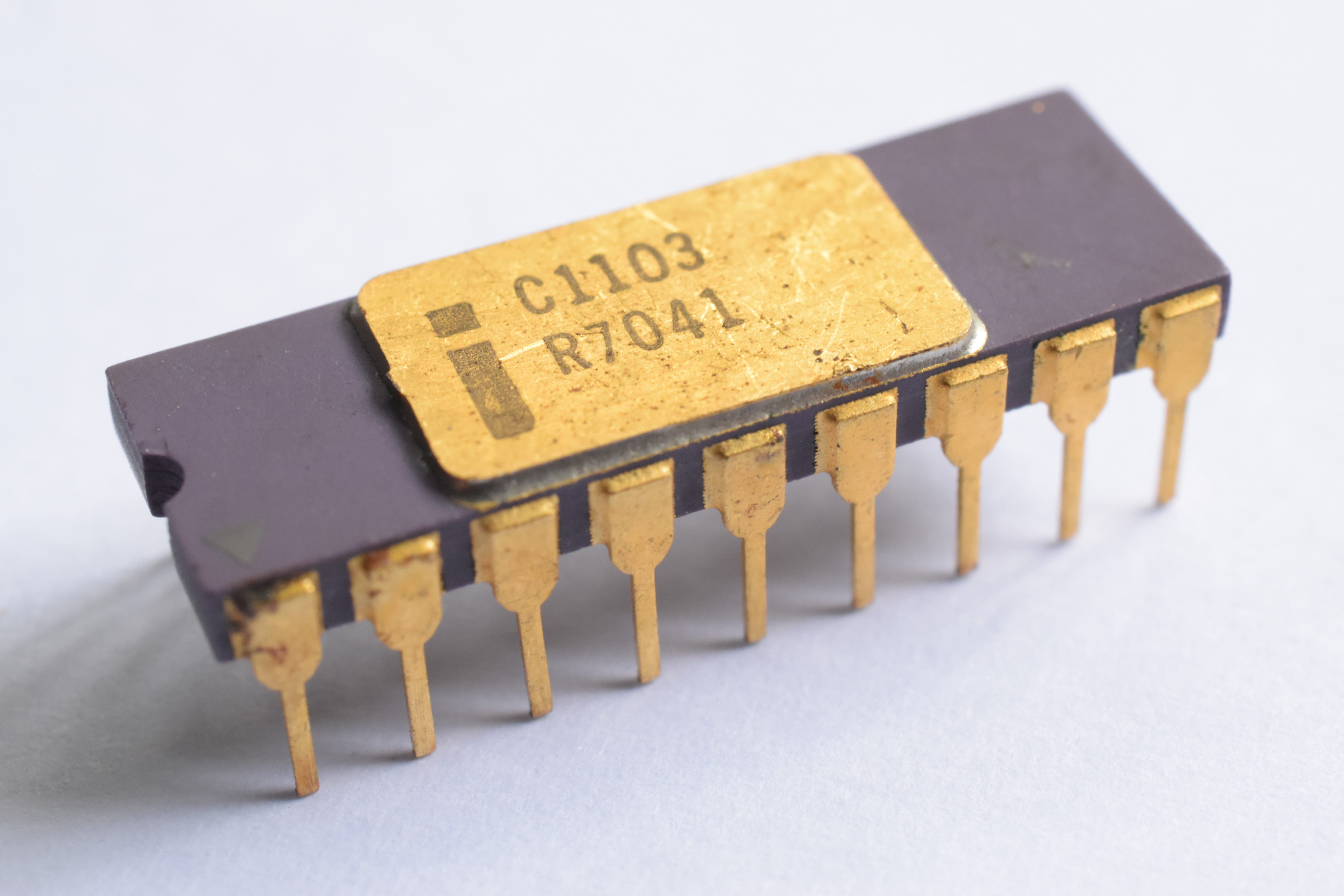
As global demand for DRAM increased over the 1970s, Japanese chipmakers were improving and managed to strike licensing deals with Bay Area firms, like Intel and Fairchild, to manufacture their designs.17 Labor was cheaper and reliability was good enough in a commodity market. Japan grew its DRAM chip industry originally thanks to American chip firms licensing frontier technology.18Though semiconductor manufacturing equipment was a small portion of Japan’s overall GDP, the country invested heavily in R&D to improve it, rising from two percent of the sector’s R&D spending at the start of the 1970s to 26 percent by 1977.19
That investment paid off: by one estimate, keiretsu fueled Japanese firms into successfully controlling 76 percent of the global DRAM market by sales. Per one US federal interagency estimate, the United States lost its lead to Japan in over 75 percent of critical semiconductor technology between 1980 to 1987.20 Soon, executives and policymakers in America were raising alarm bells.
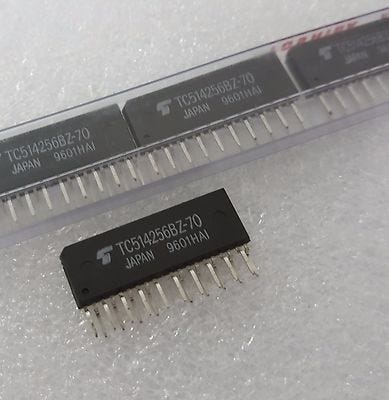
The Japanese are still fighting the war, only now instead of a shooting war it is an economic war. Their immediate intention is to try to dominate the Pacific and then perhaps the world.” - Secretary of Commerce Maurice Stans, 197121
The Bay Area lost ground in the supply chains for critical technologies at the time. As Japan’s market share grew, firms invoked national security concerns to press their case in Washington. Bay Area chipmakers Fairchild, National Semiconductor, and Intel went to Washington and asked lobbyists to broker domestic and foreign policy responses.
The Semiconductor Industry Association produced both SEMATECH—a joint industry-government research consortium—and a Ministry of International Trade and Industry (MITI)-negotiated agreement that guaranteed US suppliers “20 percent of the Japanese market for semiconductors”.22 The United States invoked policies of its own, boosted domestic manufacturing, and sharing the lead in chip demand with 43% of new global semiconductor sales against Japan’s 40% by 1993.23
“’We’re at war with Japan,’ Sporck insisted. ‘Not with guns and ammunition, but an economic war with technology, productivity, and quality.’” — National Semiconductor CEO Charlie Sprock in interview with Chris Miller24
New Arenas Above Chips
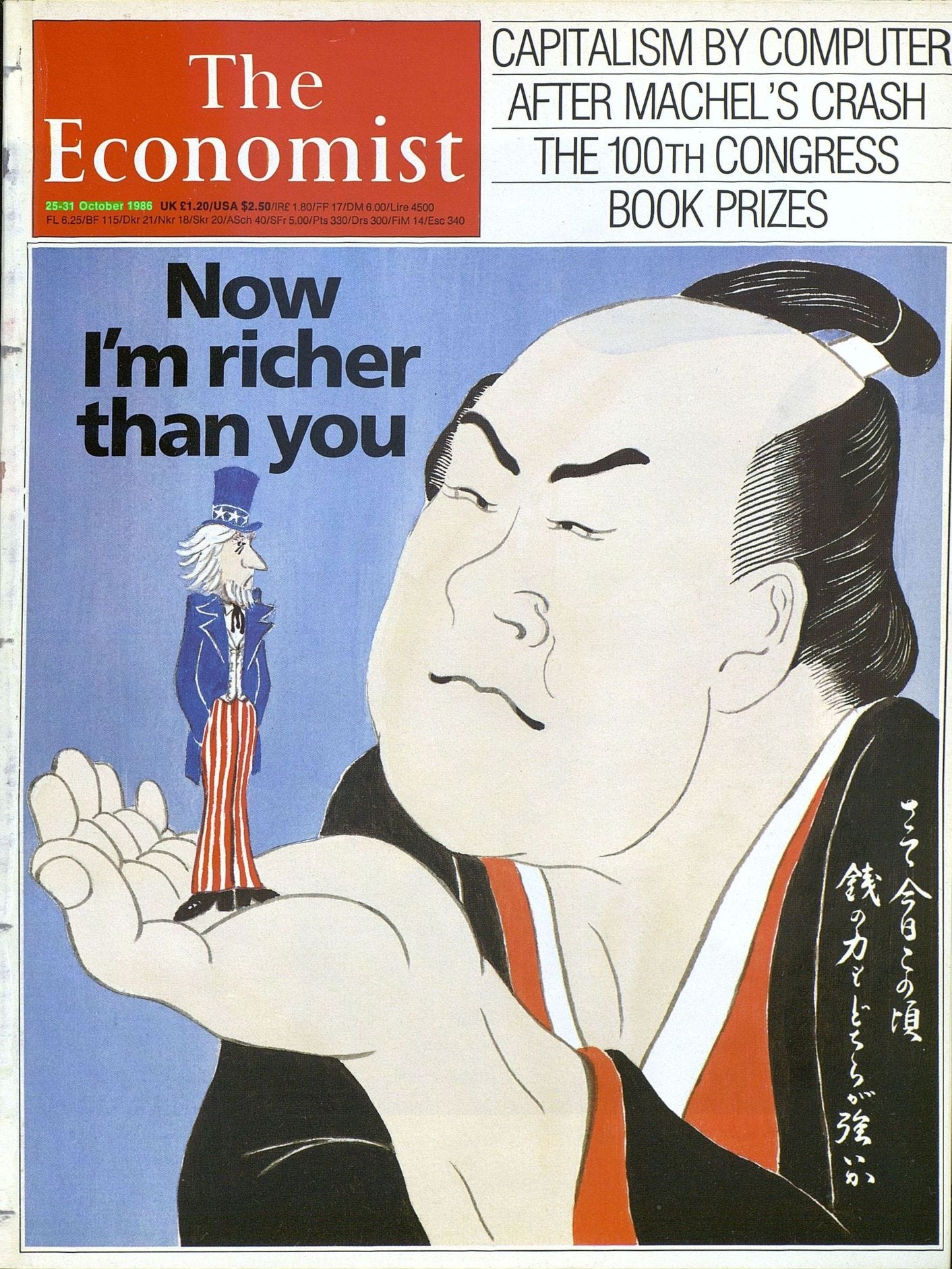
In the battle over the global chip manufacturing markets, Japanese firms captured a leading sector, but their failure to originate the next wave of innovation suggests they won the battle without winning the longer war as the world’s cluster of innovation.
Technology flows can fragment when innovations turn into indistinguishable commodities. If products made by several firms are good enough, their competitiveness compounds under state-sponsored capitalism in global free markets.
But a confluence of factors left Japan struggling to remain the center of development in the coming technological wave. In many ways, the keiretsu system stood in contrast to the characteristics at the core of the Bay Area’s cluster; picking favorites undermines the dynamism needed to innovate the new frontier. Great companies rise and must be able to fall. Japan’s most talented youth pursued high-status roles in government and large corporations rather than entrepreneurship. Policies favoring those same corporations left smaller, less visible firms with little institutional support.25
As the hardware layer of semiconductor commoditized, Bay Area startups began innovating a new wave that uses them: personal computers, microprocessors, workstations, and networking all rested on DRAM.262728
Something new was swelling in Cupertino.
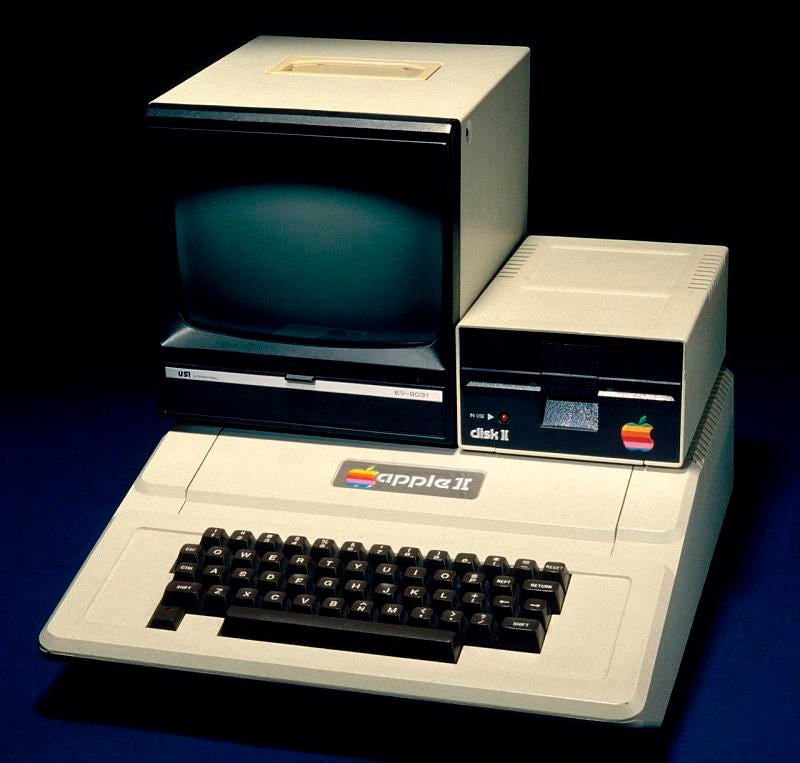
In 1976, computer hobbyist Steve Wozniak built a user-friendly desktop computer containing 4 kilobytes of DRAM. It attracted the interest of Wozniak’s friend, Steve Jobs, and inspired them to start Apple Computer. Within a year, Wozniak had created the Apple II, improving upon his initial design by adding a faster microprocessor and more DRAM. The Apple II was the first commercially successful desktop computer built with DRAM. By 1984, sales of the Apple II reached 2 million. — “DRAM” IBM Heritage29
Japan’s wider economic challenge to the United States was fading by the time the next frontier emerged. Japanese companies continued to dominate DRAM, but demand shifted towards a more differentiated market of personal computing and connectivity in the 1990s.
Up next, an unbridled Bay Area in the personal computing wave of the 1990s.
Have a great week,
Max
"Business: Japan, Inc.: Winning the Most Important Battle," TIME, May 10, 1971, https://time.com/archive/6639034/business-japan-inc-winning-the-most-important-battle/.
Telegram From the Embassy in Japan to the Department of State, December 16, 1960, in Foreign Relations of the United States, 1958–1960, vol. XVIII, doc. 203, https://history.state.gov/historicaldocuments/frus1958-60v18/d203.
Tetsuji Okazaki, "Industrial Policy in Japan: 70-Year History since World War II," Japan SPOTLIGHT, March/April 2017, 57–61, https://www.rieti.go.jp/en/papers/contribution/okazaki/06.html.
Tetsuji Okazaki, "Japan’s Industrial Policy: Objective Evaluation and Feedback Are Crucial," RIETI, https://www.rieti.go.jp/en/papers/contribution/okazaki/05.html.
Web Japan, "Economy: Japan’s Economy in an Era of Globalization" (Ministry of Foreign Affairs of Japan, 2019), https://web-japan.org/factsheet/en/pdf/e04_economy.pdf.
Paul M. Kennedy, The Rise and Fall of the Great Powers: Economic Change and Military Conflict from 1500 to 2000 (Random House, 1987), chaps. 7–8.
"Business: Japan, Inc.: Winning the Most Important Battle," TIME, May 10, 1971, https://time.com/archive/6639034/business-japan-inc-winning-the-most-important-battle/. TIME attributes the remark to "a member of the Nixon Cabinet" and does not name Stans; Michael Schaller, "The Nixon 'Shocks' and U.S.–Japan Strategic Relations, 1969–74," National Security Archive Working Paper No. 2, https://nsarchive2.gwu.edu/japan/schaller.htm, identifies Stans as the likely source.
The keietrsu model continued the practice of prior zaibatsu monopolies in many ways. For brevity sake, this narrative starts with keietrsu when comparing the difference between how companies competed in Japan versus America. https://www.vedantu.com/commerce/keiretsu
"Japan: Economic Transformation," Encyclopaedia Britannica, https://www.britannica.com/place/Japan/Economic-transformation.
Dorothy B. Christelow, "The United States' Bilateral Trade Balance with Japan: Trends in the 1970's," Federal Reserve Bank of New York Research Paper No. 7905 (May 1979), p. 2
Business: Japan, Inc.: Winning the Most Important Battle," TIME, May 10, 1971
https://time.com/archive/6639034/business-japan-inc-winning-the-most-important-battle/
New Argonauts chapter and page missing
Jeffrey Ding, Technology and the Rise of Great Powers: How Diffusion Shapes Economic Competition (Princeton University Press, 2024), chap. 5, "Japan’s Challenge in the Third Industrial Revolution."
https://www.landley.net/history/mirror/timelines/inventors/html/aa100898.htm
In the literature of technology history, recent scholarship observes the rise of Japan in the beginning of a third industrial revolution “IR-3” that came to emerge over the course of the second half of the 20th century.
"Dynamic Random-Access Memory (DRAM)," IBM Heritage, https://www.ibm.com/history/dram.
"The Intel 1103 DRAM," Intel, https://timeline.intel.com/1970/the-intel-1103-dram. Intel reports that by the end of 1971 the 1103 was the best-selling semiconductor device in the world, and that by 1972 fourteen of the eighteen mainframe makers in the United States, Europe, and Japan relied on it.
Claude - recall our conversation and fix this citation to stay condensed here. Citation for all four quotes: Michael Borrus, James Millstein, and John Zysman, International Competition in Advanced Industrial Sectors: Trade and Development in the Semiconductor Industry, study prepared for the Joint Economic Committee, U.S. Congress, 97th Cong., 2d sess. (Washington, DC: U.S. Government Printing Office, February 18, 1982), 83, 84, 108, 128.
Hideki Tomoshige, "Japan’s Semiconductor Industrial Policy from the 1970s to Today," Center for Strategic and International Studies, 2022, https://www.csis.org/blogs/perspectives-innovation/japans-semiconductor-industrial-policy-1970s-today.
Ding, Technology and the Rise of Great Powers, chap. 5.
Chris Miller, Chip War: The Fight for the World’s Most Critical Technology (Scribner, 2022), 86.
E. Floyd Kvamme, "Life in Silicon Valley: A First-Hand View of the Region’s Growth," in The Silicon Valley Edge: A Habitat for Innovation and Entrepreneurship, ed. Chong-Moon Lee, William F. Miller, Marguerite Gong Hancock, and Henry S. Rowen (Stanford University Press, 2000), 69.
The Economist, 25 October 1986, p15, See page 3-4 of https://www.ifo.de/DocDL/cesifo1_wp12097.pdf,
Dado P. Banatao and Kevin A. Fong, "The Valley of Deals: How Venture Capital Helped Shape the Region," in The Silicon Valley Edge, 300.
AnnaLee Saxenian, The New Argonauts: Regional Advantage in a Global Economy (Harvard University Press, 2006), 196.
Miller, Chip War, chap. 28.
Semiconductor History Museum of Japan, "80s Trends in the Semiconductor Industry," https://www.shmj.or.jp/english/trends/trd80s.html; and "90s Trends in the Semiconductor Industry," https://www.shmj.or.jp/english/trends/trd90s.html.
Saxenian, The New Argonauts, 23, 126.