


Welcome to one last rodeo on this special tour,
Today’s short chapter concludes our time with “Bay Area Abroad: Innovation through Fragmentation”. It’s just 7 paragraphs and a few snappy tables that tries to tie together like 20,000 words total—and way many more deleted— devoted to understanding how Bay Area technology companies navigate geopolitics.
Table of Contents: Introduction | How the Bay Area Makes New Tech | The Cold War | Japan | Globalization of the 1990s | China into Today | Today’s Fragmenting Flashpoints | Assessing The Engine & The Exposure | Conclusion
Thank you for reading, claiming to, and providing feedback. Who knows where this writing will lead. I have a gazillion ideas, but this is its first showing ahead of showing up at BACEI. Any feedback is welcome.
Assessing the Engine and Exposure
Bay Area technology flows risk fragmenting. At home, the domestic engine remains strong, attracting outsized investment and astounding profit. However, the pipeline of talent risks cracking. The bar to immigrate, study, and work is rising; that undermines retaining a healthy base of high-skilled foreign talent to research and work across Bay Area universities and companies.
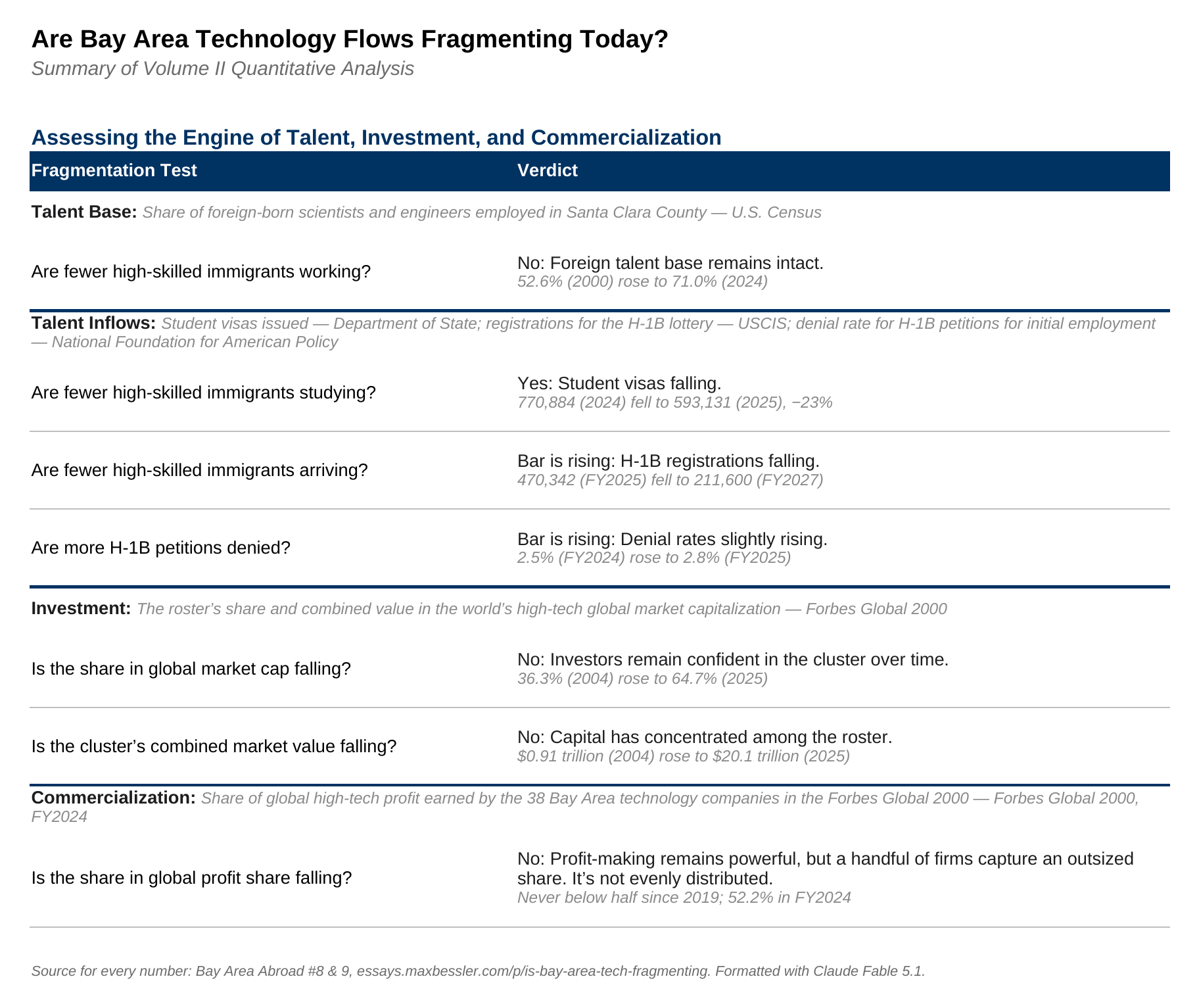
Overseas, companies appear to be hedging their commercial activity depending on their core business lines. More profits are being reported at home by the median firm, in part due to new incentives that reward companies for reporting in the United States the foreign sales of U.S.-held intellectual property. Consumer-facing, digital-born companies see demand remain widely distributed. New physical projects appear to be shifting away from rival-bloc destinations, such as China, and toward allied markets like India.
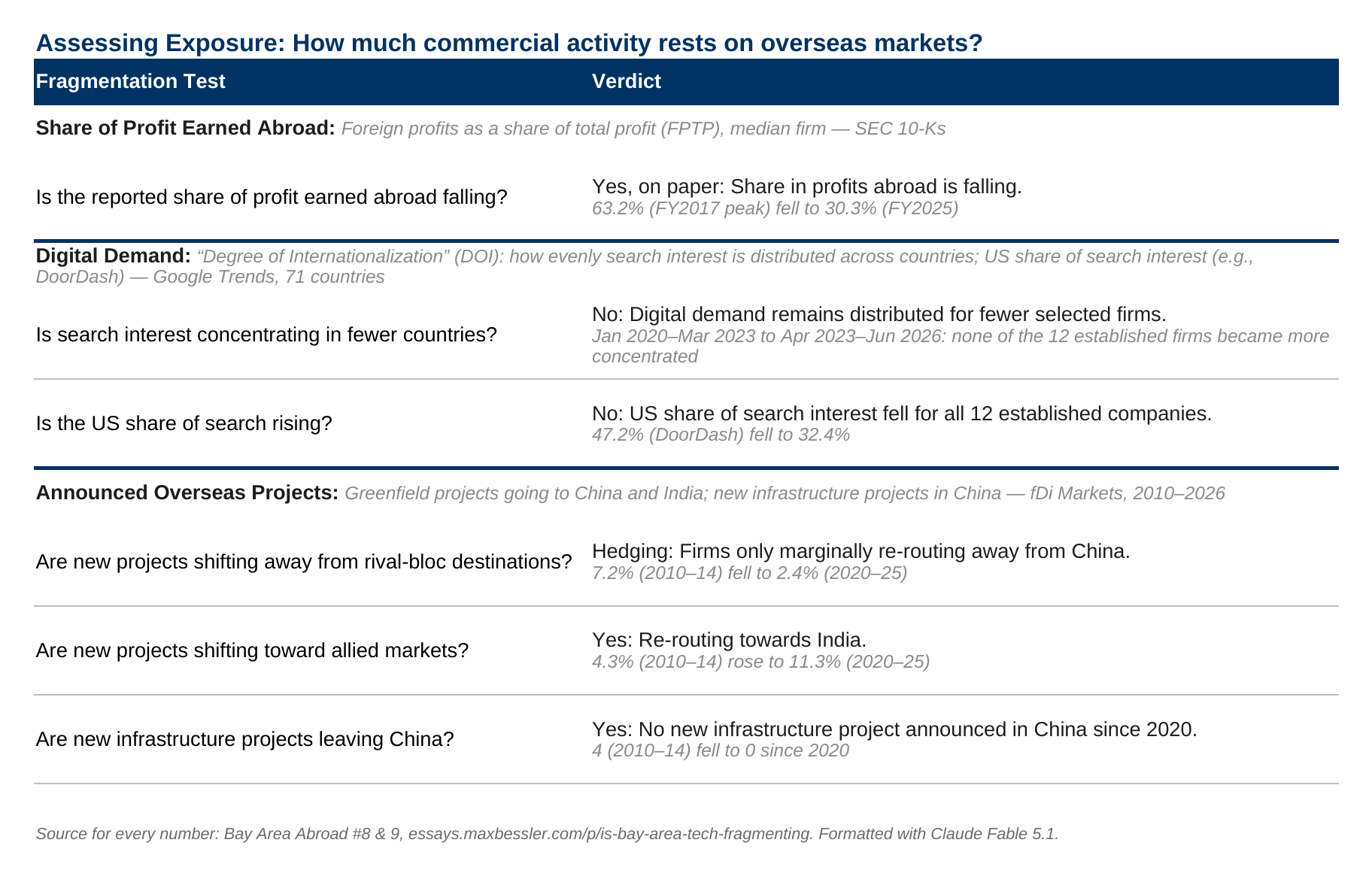
Future research should compare fragmentation metrics against each other. Start with two pairings: profit share against FPTP, and talent inflows against new project announcements. Even as global profit share has stayed above half since 2019, the reported foreign profit share on 10-Ks has fallen, likely in part due to incentives that lure businesses to report foreign income at home. Perhaps most apparent is Meta, which reports just 6.1% of foreign profit abroad in FY2024—likely as a result of generating sales not from customers but from advertisers and other digital sources not tied to a specific geographic location1—yet the digital platform giant scores a DOI of 0.707 and reports 3.6 billion daily active people around the world across its family of apps.
Companies which manage to operate with light assets carry a double-edged dagger when competing in overseas markets. These consumer-facing, digital-born companies lack assets—e.g., subsidiaries, employees, and physical projects—that entrench them in host countries.2 That makes it easier for fragmentation to arise. A government could block access. So, they might be less exposed operationally to geopolitics, but they are also more vulnerable to losing their customer base of users.
Additionally, comparing talent inflows and greenfield announcements for India shows a conundrum for policymakers of competition and cooperation. Student visas issued to India, the largest sender of students, fell 60.5% in 2025, even as India’s share of new greenfield projects rose from 4.3% (2010–14) to 11.3% (2020–25). By contrast, China is consistent across talent and projects. Student visas issued to China fell by 30.3% and its share of new projects shrank from 7.2% to 2.4%. On one hand, the influx of high-skilled labor can debase the national pipeline to upskill homegrown talent; on the other hand, restricting talent inflows hurts the brain circulation3 that may produce advantageous overseas investments.
The History of Bay Area Tech Flows Fragmenting
Five distinct geopolitical eras shed light on how geopolitics influence the behavior of Bay Area technology companies. Whether they face direct foreign competition or not, Washington always plays a role. When threats to national security arise, restrictions on flows follow. This appeared during the Cold War against the Soviet Union with CoCom and remains true today with export controls on semiconductors to keep China behind the frontier. As with Japan and later China, competition was once two economies full of firms cooperating: trade divided production to mutually benefit firms spread along the value chain. The Bay Area played a supportive role in helping grow rival economies of Japan and China, fragmenting its own market position abroad. Chasing cheaper margins leads to technology transfer. In the rare moments of no economic or military competition, Washington steps out of the way by easing the restrictions that fragment. Today, the world risks Washington playing a heavier hand as flashpoints around the world risk fragmenting technology flows.
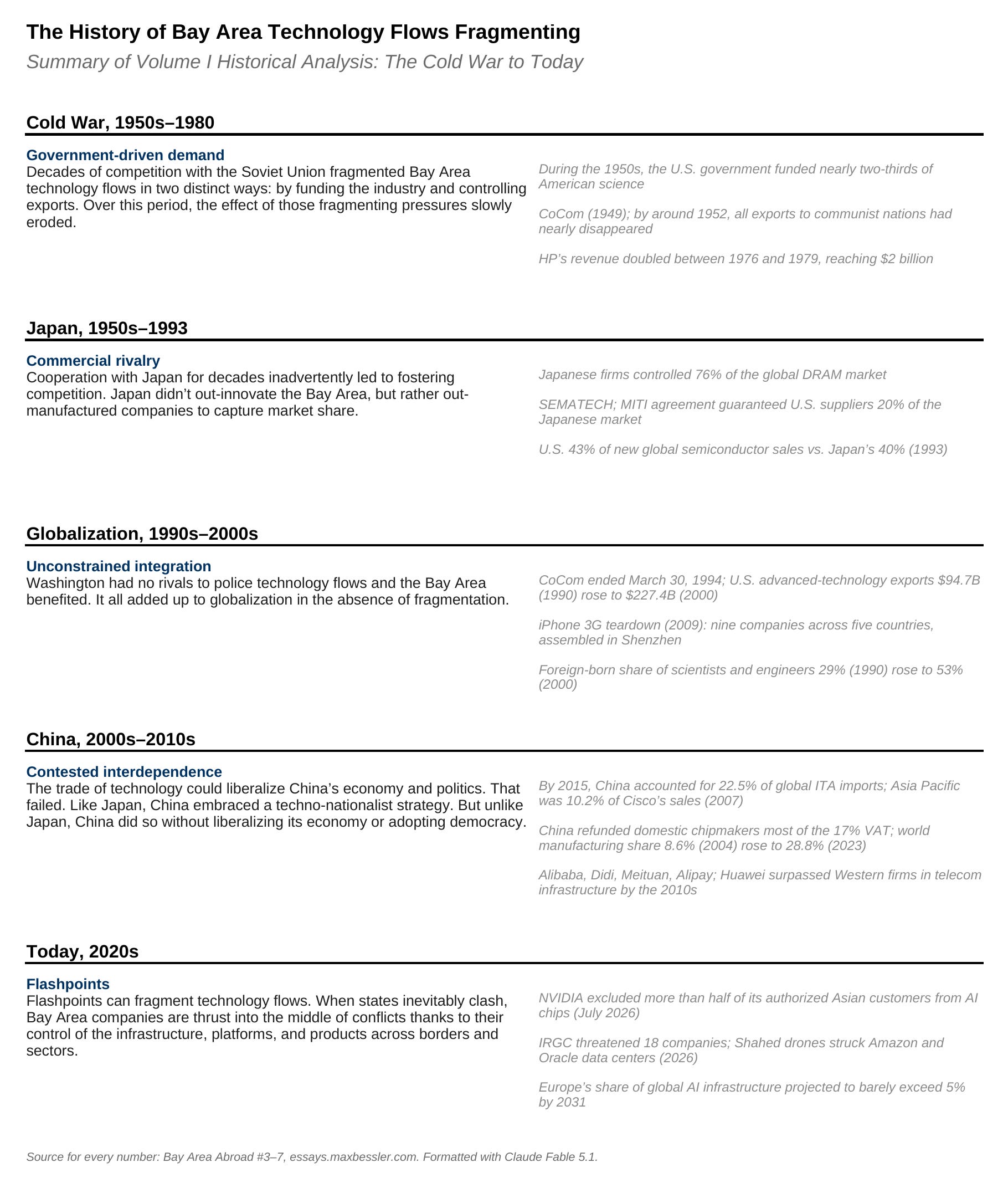
Bay Area technology firms are hedging against a future that further fragments trade along geopolitical tensions. Flashpoints could escalate into provoking Washington to play a heavier hand in guiding trade flows like prior eras of competition with the Soviet Union and Japan. The remnants of aggressive globalization remain, preventing Washington from insulating the Bay Area engine’s ability to reach markets worldwide. Through every era, a pattern has held: the Bay Area engine has produced waves of innovation; great companies that must navigate geopolitics will continue to rise and fall.
Thanks for reading friends.
I leave for the United Kingdom Saturday.
I’m drafting completely different pieces. No tech to follow!
Max
Harald Puhr, Jakob Müllner and Claudia Trentini, “An Innovative Measure for Digital Firms’ Internationalization,” Transnational Corporations 30, no. 3 (2023): 130.
Puhr, Müllner and Trentini, 137; see also 130.
AnnaLee Saxenian, “Brain Circulation: How High-Skill Immigration Makes Everyone Better Off,” The Brookings Review 20, no. 1 (Winter 2002), https://www.brookings.edu/articles/brain-circulation-how-high-skill-immigration-makes-everyone-better-off/.