


Welcome back everyone,
Today’s the second chapter in the “Bay Area Abroad: Innovation through Fragmentation”. It’s a side product emerging from work with the Bay Area Council Economic Institute that’s generously letting me republish ahead of its full release with them.
I try to briefly introduce how, from the ground up, the Bay Area creates technology companies capable of influencing geopolitics. People research new breakthroughs and then build companies that commercialize them worldwide.
Talent + Funding → Commercialization.
The more I interviewed researchers and investors (and read my way into a migraine), the more I felt compelled to write this framing chapter: grounding “theory” about how technology companies from the Bay Area manage to keep appearing in modern history’s grandest stories. If any of this interests you, please don’t hesitate to reach out; I discovered many branches that grow this.
As always, I need your help. We’ve already found typos and tweaked the name of the report. Keep steering me towards better work. What’s missing? What needs clarifying? Is this all a headache? How about the charts?
Table of Contents: Introduction | How the Bay Area Makes New Tech | The Cold War | Japan | Globalization of the 1990s | China into Today | Today’s Fragmenting Flashpoints | Assessing The Engine & The Exposure | Conclusion

An Engine of Innovation
The Bay Area economy can be thought of as an engine that powers waves of innovation. This cluster fuses skilled talent with flush funding to successfully commercialize new technology. Unlike other economies, the Bay Area’s unique in that it maintains world-class competitiveness through flexibility.
“The Bay Area has managed to move from semiconductors to operating systems, to smartphones, to social networks, to now space, and then AI, fairly seamlessly… where other hubs rarely are able to go beyond their initial technology.” —Interview with Mehran Gul, Author of The New Geography of Innovation1
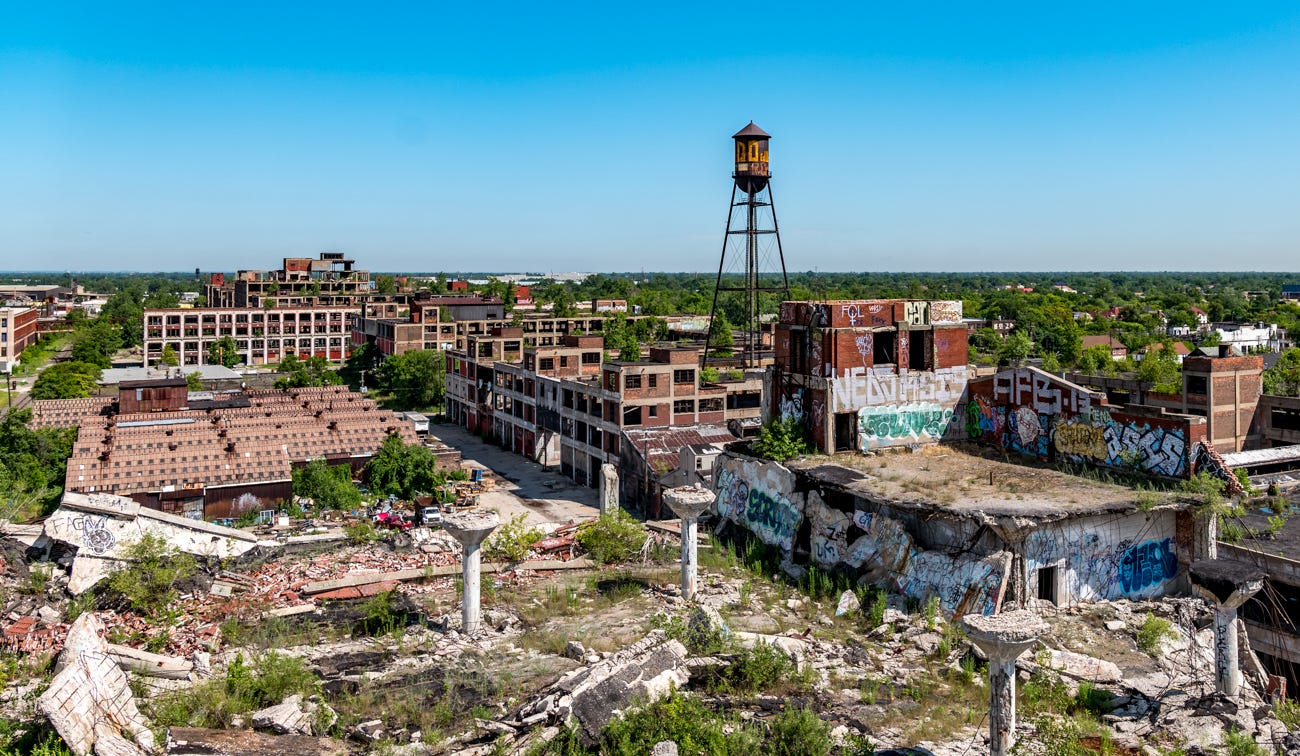

Detroit once led in cars and Pittsburgh dominated steelmaking, but not anymore. The Bay Area avoids a similar fate by not resting on one particular technology; instead, it preserves the ability to innovate. As Mehran Gul notes, “Places where scientific breakthroughs are happening are not necessarily the places where those breakthroughs have also been monetized.”2 Global companies continue to emerge out of the Bay Area by successfully commercializing research.
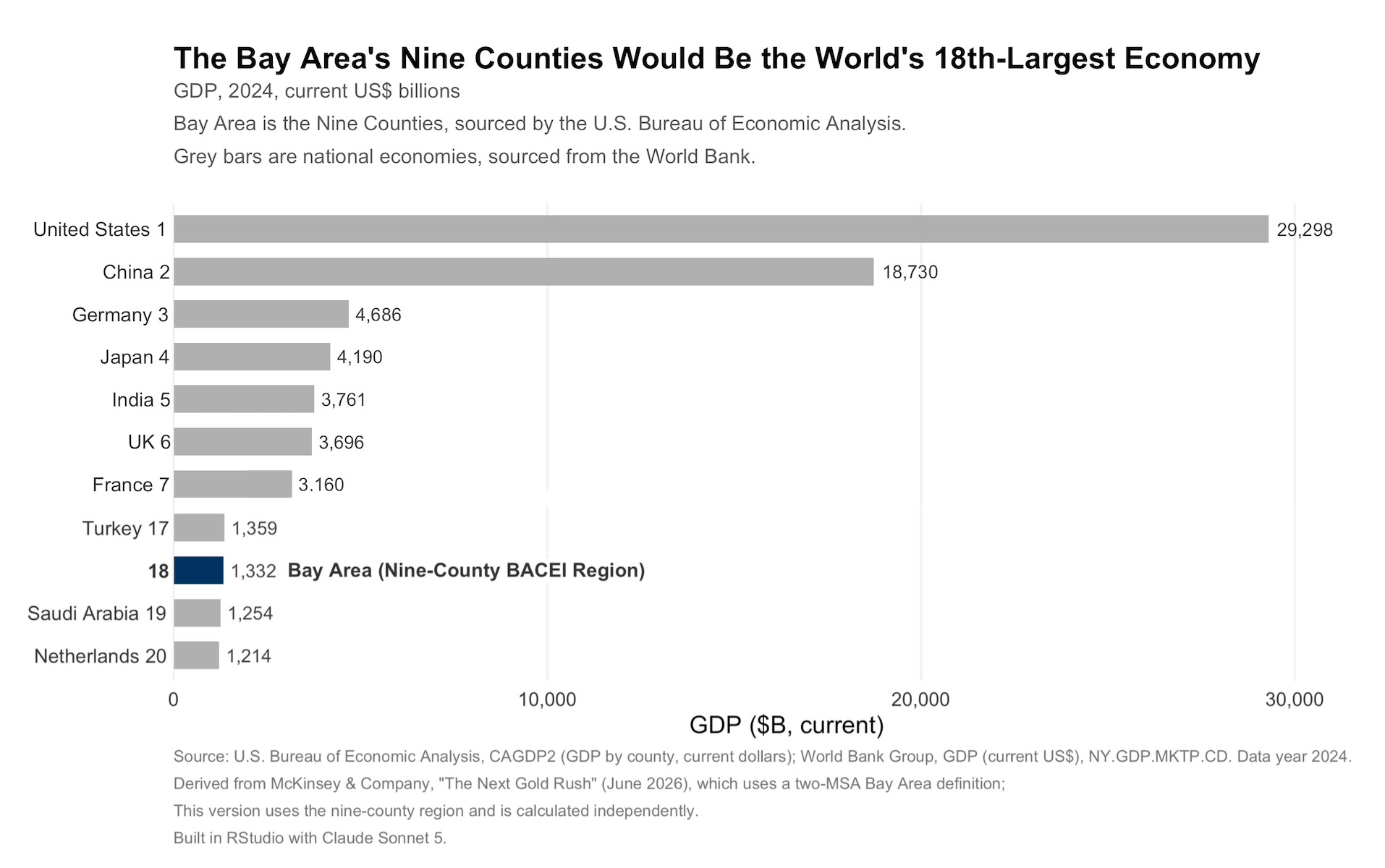
This engine powers an extraordinary economy. If it were its own country, the nine counties would make it the 18th largest economy in the world by GDP—roughly $1.3 trillion in 2024—on par with wealthy oil states in the Middle East and larger than many developed nations worldwide. Technology companies play a central role: Santa Clara County—home to Apple, Google, NVIDIA, and Meta—generated $506 billion in 2024.3 This strength lies in three key components.
Talent + Funding → Commercialization
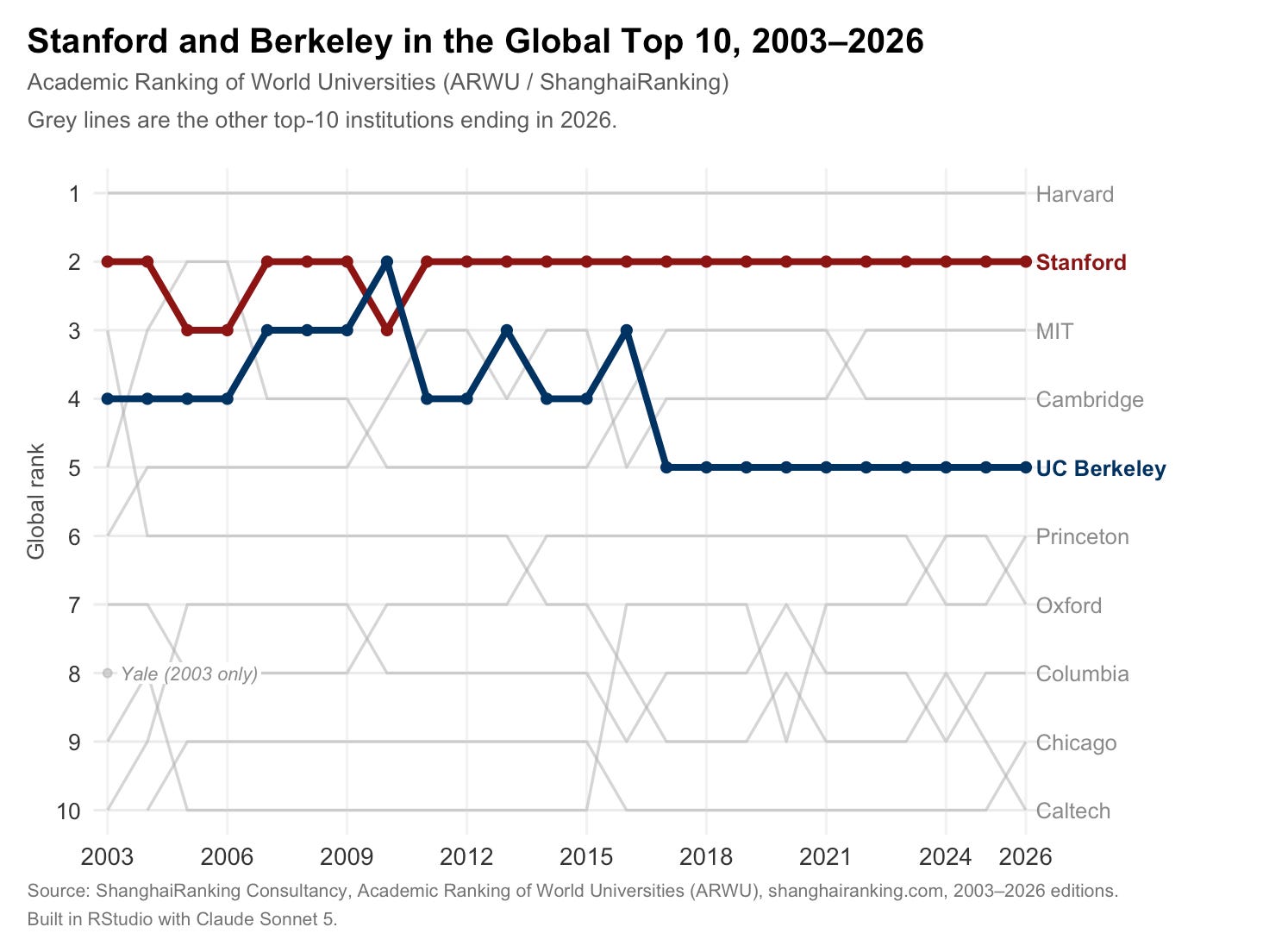
Innovation requires skilled talent. The Bay Area ranks among the best in the world in technology education and research. The University of California (UC) school system and Stanford University consistently land as leaders in global lists. In 2025, UC Berkeley was ranked the #1 Public Research University and #5 Global University per the 2025 Academic Ranking of World Universities. Stanford University has been in second place in global overall rankings for nearly two decades.
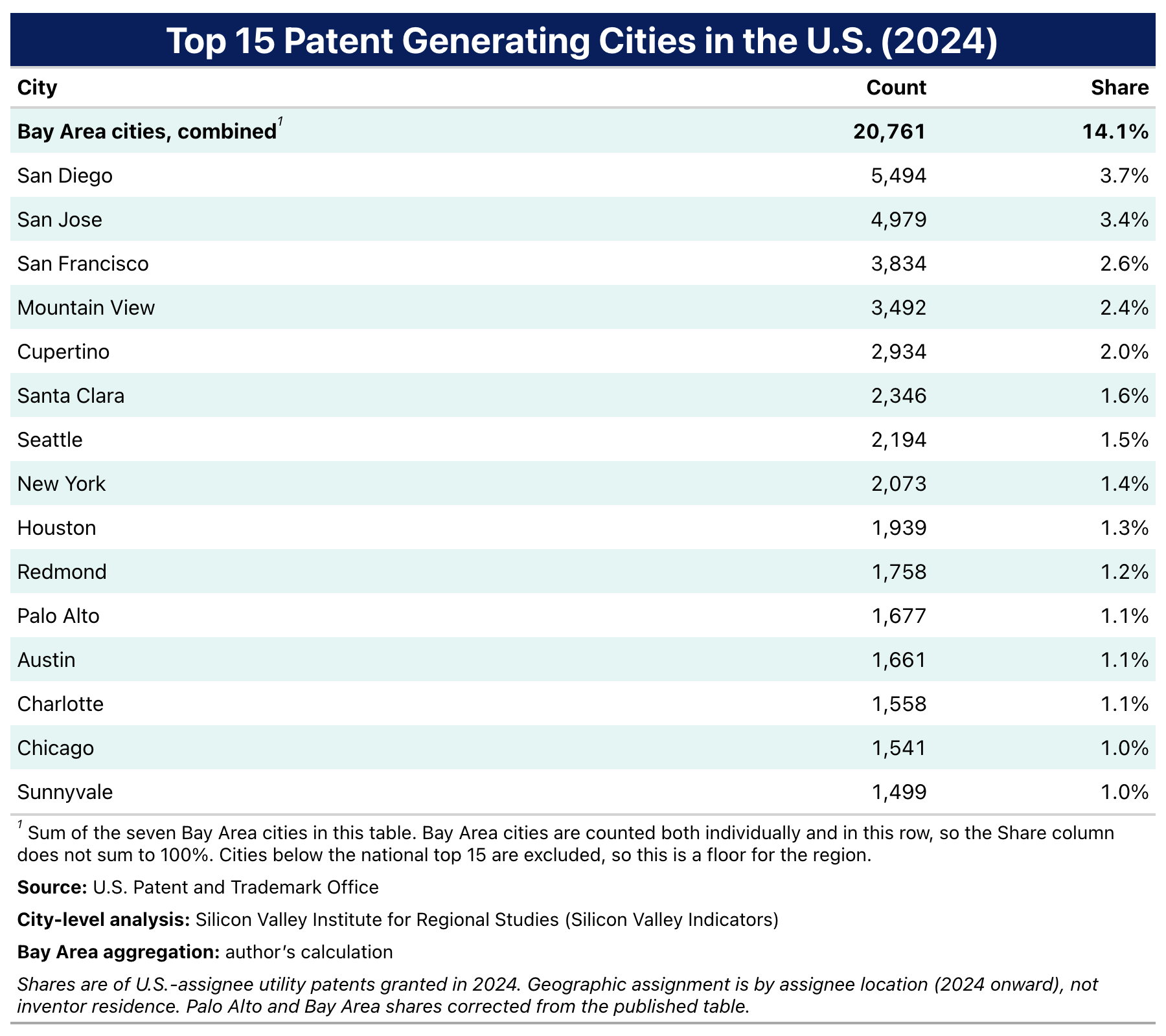
For technology research, the Bay Area region leads the United States in patents. In 2024, the region generated 20,761 patents, 14.1% of the US total, and more than the next four US cities combined.4
Funding
The leaps in research emerging from schools and companies would not be possible without flush funding for researchers in academia and investors from the private sector.
In academia, Stanford University in 2025 reported funding over 7,500 externally sponsored awards, with total support revenue of $2.3 billion during the fiscal year; 70% was funded by the federal government.5
Robust venture capital powers the Bay Area’s ability to innovate, but it wasn’t always this way. Since World War II, the Bay Area slowly grew its venture capital industry, overtaking the Cambridge-Boston area as the destination for global technology entrepreneurship.6 By 1995, Silicon Valley’s share of all VC investment was 22.6%, over twice New England’s 9.9% share.7
A cultural advantage emerged in the Bay Area over east coast clusters. In contrast to the tradition of “the company man”—coupled with California not enforcing non-compete clauses—talent moves more fluidly around the region and sparks breakthroughs across domains. Technologists in the Bay are loyal to the act of innovating new technology rather than their companies.
“I knew people who worked for the minicomputer companies back east, and if you went from one company to another, you were considered a traitor, people shunned, they wouldn’t even talk to you.” —John L. Hennessy, Chairman of the board of directors of Alphabet, in The New Geography of Innovation 8
Skilled researchers innovate with funding— plentiful in the Bay Area. Its investors tolerate high risk and are willing to risk capital on moonshot bets. Today, California has received more than $366 billion in venture capital funding since the beginning of the year; that’s over three times more than the other 49 states combined. Two San Fransisco companies, OpenAI and Anthropic, comprise $217 billion of it.9
Commercialization
Talent and funding alone do not create companies that play roles in geopolitics. To do so requires successful commercialization: turning a profit, performing above costs, continually researching and developing technology capable of diffusing into markets.
Which part of this engine powers the geopolitical strength of the United States? Answering that question falls outside the scope of this observational report. The debate is active today how innovation underpins geopolitical power. Is it the Bay Area’s ability to innovate first and preserve the edge in leading sectors? Or does US leadership emerge, in-part, from the strength of Bay Area companies thanks to successful diffusion of those inventions?10 Regardless, when the engine makes companies that sell new technologies worldwide, few contest their presence in world affairs.
The rest of this report lives at this level: examining how the Bay Area companies that successfully commercialized new technology shape, and are shaped by, world affairs since the Cold War.
Up next, the Cold War.
Thanks for being here,
Max
Mehran Gul, interview with the author, June 30, 2026.
Mehran Gul, The New Geography of Innovation: The Global Contest for Breakthrough Technologies (Simon & Schuster, 2026).
Mehran Gul, interview with the author, June 30, 2026.
BACEI presentation, Randolph, Jan. 2026, Slide 12; source: U.S. Patent and Trademark Office, analysis by the Bay Area Council Economic Institute.
Stanford University, "Research and Innovation," Facts, Stanford University, accessed September 15, 2026, https://facts.stanford.edu/research.
For more into the rise of Silicon Valley’s technology ecosystem overtaking the East Coast’s, see: AnnaLee Saxenian, Regional Advantage: Culture and Competition in Silicon Valley and Route 128 (Harvard University Press, 1994).
Anil K. Gupta and Haiyan Wang, "The Reason Silicon Valley Beat Out Boston for VC Dominance," Harvard Business Review, November 15, 2016, https://hbr.org/2016/11/the-reason-silicon-valley-beat-out-boston-for-vc-dominance.
Interview sourced from Mehran Gul’s The New Geography of Innovation: The Global Contest for Breakthrough Technologies (Simon & Schuster, 2026). Page 90
Paul Kiernan, "California Draws More Startup Investment Than All Other 49 States Combined," The Wall Street Journal, August 20, 2026, https://www.wsj.com/tech/ai/californias-ai-dominance-fuels-366-billion-venture-capital-bonanza-820e9bde.
For more into this debate between the competing 'leading-sector' (R&D + funding-first) and 'GPT diffusion' (commercialization and adoption-first) theories of how technological revolutions drive great-power competition, see Jeffrey Ding, Technology and the Rise of Great Powers: How Diffusion Shapes Economic Competition (Princeton University Press, 2024), chap. 2 and chap. 4.